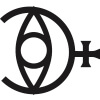
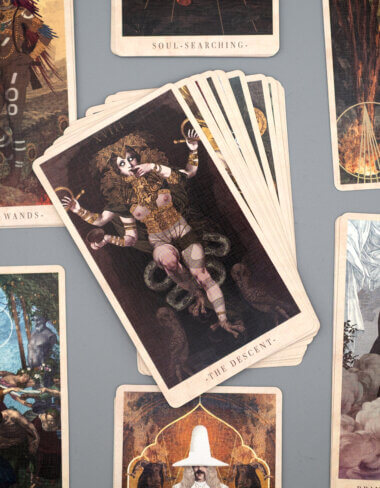
Magnesia cannot be easily extinguished. It represented the secret element of transformation for the alchemists – just as our tarot decks do.
It demands change and evolution to refine ourselves. “…an alchemist must have in himself the ‘magnesia,’ which means the magnetic power to attract and ‘coagulate’ invisible astral elements.” – Paracelsus
We leave you with one of the most unique explanations about Magnesia:
“(…) It is something like common quicksilver, but of such a celestial and transcendent brightness, that nothing on earth can be compared to it. It is the child of the elements, a pure virgin, from whom nothing has been generated as yet. When she breeds, it is by the fire of Nature, which is her husband. She is neither animal, vegetable, nor mineral, nor is she an extraction from these ; she is pre-existent to them all, and is their mother. She is a pure simple substance, yielding to nothing but love, because generation is her aim, and that is never accomplished by violence. She produces from her heart a thick, heavy, snow-white water, which is the Lac Virginis, and afterwards blood from her heart. Lastly she presents a secret crystal. She is one and three, but at the same time she is four and five. She is the Catholic Magnesia, the Sperm of the World, out of which all natural things are generated. Her body is in a sense incorruptible ; the common elements will not destroy it, neither does she mix with them essentially. Outwardly she resembles a stone, and yet she is no stone. The philosophers call her their white gum, water of their sea, water of life, most pure and blessed water; she is a thick, permanent, saltish water, which does not wet the hand, a dry water, viscous, slimy, and generated from the saline fatness of the earth. Fire cannot destroy her, for she is herself fire, having within her a portion of the universal fire of Nature, and a secret, celestial spirit, (…) She is a middle nature between thick and thin, not altogether earthly, not wholly igneous, but a mean aerial substance, to be found everywhere and at all seasons.” – [Appendix III] A short lexicon of Alchemy, The Hermetic and Alchemical Writings of Paracelsus, Book II, Arthur Edward Waite (1894)


 No products in the cart.