
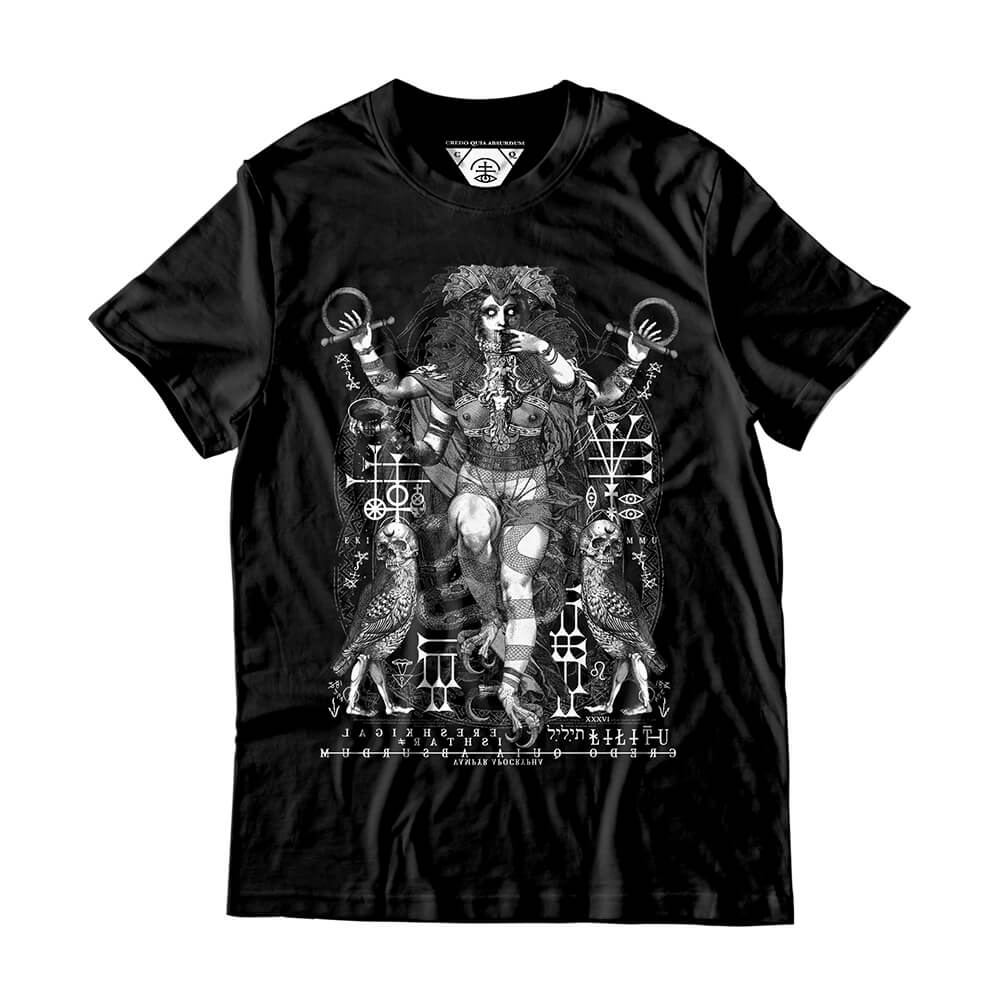
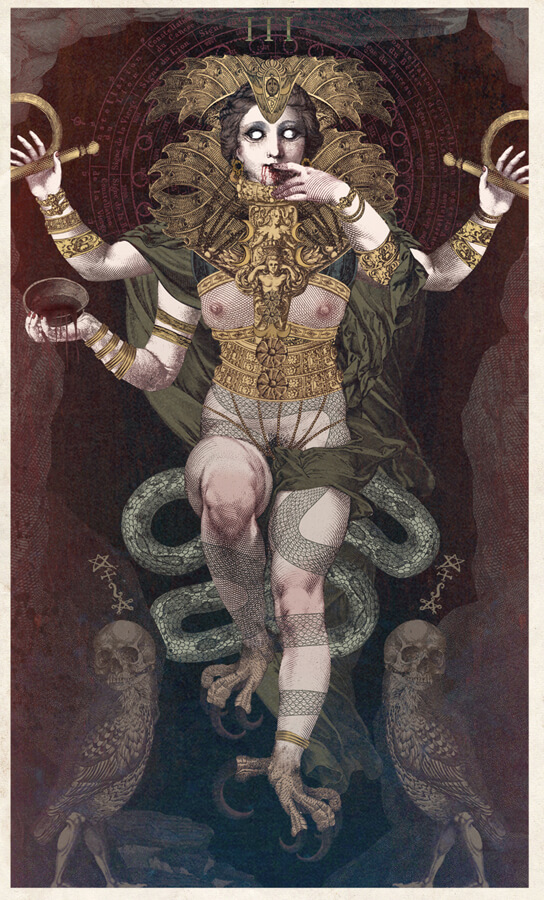
The Nameless Mother reflects a free interpretation of the well known “Burney Relief” aka “Queen of the Night relief”, a powerful artifact that haunts a hallway of the British Museum.
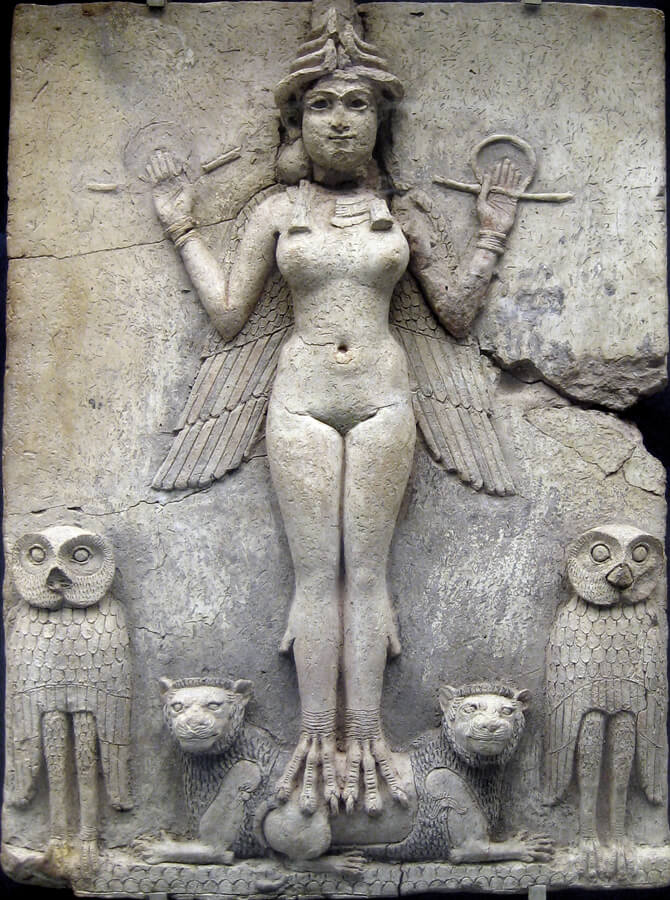
This terracota high relief is a mysterious piece originally discovered in southern Iraq, dated probably between 1800 and 1750 BCE (old Babylon). Its exact find-site remains unknown due to the lack of records, generating some doubts of its authenticity. The main character on this plaque has been the subject of debate for a very long time and it seems that there is no agreement regarding the true identity of the featured goddess.
Some argue that she’s Lilith, a female demon from the Ancient Mesopotamian religion – assuming sometimes the role of first wife of Adam as in the Judaic tradition. Others find a curious relation between the elements on the plaque and other artistic representations (from the same period) of Ištar, a goddess of beauty and sexual love (but equally prominent as the goddess of warfare) whose name is many times translated as “the lady of the heavens”.
Please note that the goddess “Ištar” for the Babylons is exactly the same deity as “Inanna” for the Sumerians. We might switch her name to her Babylon or Sumerian form according to the texts we use as reference. Hope you don’t get confused.
When we started studying the figure displayed on this relief we were almost sure that she was Ereškigal, Ištar’s elder sister and queen of Kur (Irkalla, Kukku, Arali, etc), the land of the dead in Mesopotamian tales of creation.
There are almost no depictions known of this goddess – but we assumed that she could embody Ištar’s physical attributes to represent her darker side. We were looking at Ištar as a deity of light, but further research showed us that she wasn’t that nice, revealing some violent and fearsome characteristics, especially well described by the Epic of Gilgamesh.
It is true the both goddesses could fit on the terracota’s figure, showing the darker side of them and their sexual attributes at the same time. However, investigating a little more of Ištar’s mythological narratives we found important details that changed our minds.
An ancient Sumerian poem (c. 2047–1940 BCE) chronicles Inanna’s (Ištar in Babylon) descent to the nether world, where she demanded to enter to attend the funeral rites of Gugalanna, the husband of Ereškigal. Other perspectives suggest that Inanna/ Ištar’s journey could be motivated by the ambitious desire to increase her own knowledge (Like a shadow work and self-discovery).
“From the great heaven she set her mind on the great below. From the great heaven the goddess set her mind on the great below. From the great heaven Inana set her mind on the great below. My mistress abandoned heaven, abandoned earth, and descended to the underworld. Inana abandoned heaven, abandoned earth, and descended to the underworld.”
“Inana’s descent to the nether world”: Translation by the Electronic Text Corpus of Sumerian Literature. Oxford University
Passing through the seven gates of that place of damnation (compared to the 7 planets according to some esoteric traditions), she had to undress her clothing and adornments in order to move on. By the time Inanna reaches Ereškigal’s court she is completely naked.
“Ishtar thereupon descends through the seven gates which lead downward into the depths of the underworld. At the first gate the great crown is removed from her head, at the second gate the earrings from her ears, at the third gate the necklace from her neck, at the fourth gate the ornaments from her breast, at the fifth gate the girdle from her waist, at the sixth gate the bracelets from her hands and feet, and at the seventh gate the covering cloak of her body. Ishtar remonstrates as each successive article of apparel is taken from her, but the guardian tells her that this is the experience of all who enter the somber domain of death.” – Manly P. Hall, “The Secret Teachings of All Ages”, 1928.
In her journey through the netherworld, Inanna was eventually cursed and killed by her sister, becoming part of the underworld kingdom. It is said that the death of the goddess affected the fertility on earth, denying the plants to grow up and the animals to mate.
In reaction to the withering of the planet, Ea (god of wisdom and water) managed to revive the dead goddess. However, her place in the underworld cannot be left empty, so her consort, Tammuz (aka Dumuzid) accepted to replace her in the house of the dead.
According to the myth, Inanna/Ištar was able to find an agreement with Ereškigal, allowing Tammuz to spend half of the year on earth.
This symbolic conclusion defines the cycles of life on Earth, the time Tammuz live in the dark domain are like the Autumn and Winter and sequentially, when he comes back to the earth, so it comes the Spring and Summer – Very similar to the cycle of “death and rebirth” of Persephone in greek mythology.
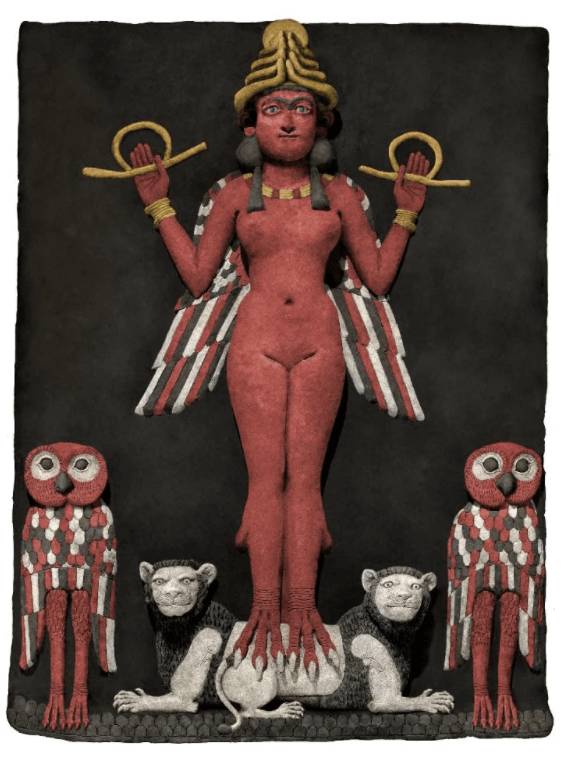
The iconography presented in the “Burney Relief” matches this episode from the epic Sumerian poem (that has a very similar akkadian version). The nude female is an extremely common theme in ancient Near Eastern art, in this particular case, it exalts her affiliation to the sexual love and may not refer her condition while in the realm of the dead.
It is interesting to note that she still wears some clothing/accessories such as her turban/horned crown (above all a symbol of her divinity and lordship). Her earrings (sometimes interpreted as hair) and necklace can be seen too, although they’re slightly destroyed. She also keeps her bracelets, so I dare to say that this representation of the goddess may portray her at the gates of the Netherworld, before her dramatic entrance and symbolically representing the passage from Summer to Autumn in nature’s cycle.
The lionesses at her feet are very popular symbols on the deity’s portraits (“In praise of her warlike qualities, she is compared to a roaring, fearsome lion”), so it is not surprising to see them in here, so they personify her courage and determination:
“Like a fearsome lion you pacify the insubordinate and unsubmissive with your gall.” -“Inanna and Ebih” translated by: Black, J.A., Cunningham, G., Robson, E., and Zólyomi, G., The Electronic Text Corpus of Sumerian Literature, Oxford 1998.
Her wings are also very common in many representations and they refer to her highness as queen of the “great heavens”. Looking at her feet we can see the claws that are commonly associated with some Sumerian demons, such as Lilith or Ereškigal.
All her menacing characteristics are described in the priestess Enheduanna’s poetry (23rd century BCE) – Her glance caused crops to wither and cattle to perish, leaving destruction in their wake.
As a goddess of war Inanna was described herself as a lioness who “show wet fangs/ gnashes her teeth” and also as an eagle: “O winged Lady, Like a bird You scavenge the land.”; “her fiendish wings flap in foreign lands”- I underline the depiction of her feet that resemble the eagle claws as a common attribute.
Personally, I believe they’re connected to her ferocious personality. “When Inana arrived at the Netherworld, she pushed aggressively on the door of the underworld and she shouted aggressively at the gate of the underworld”. Some ancient references actually explain that her “feet are continually restless”.
We should not forget that she’s the unified manifestation of all that is pleasurable and beautiful, as well as she defines torment and suffering. This duality appears to be normal among the gods in ancient religions, so her ”evil” bird claws may be considered as a symbol of her most negative attributes, attached to her violent qualities as the goddess of war.
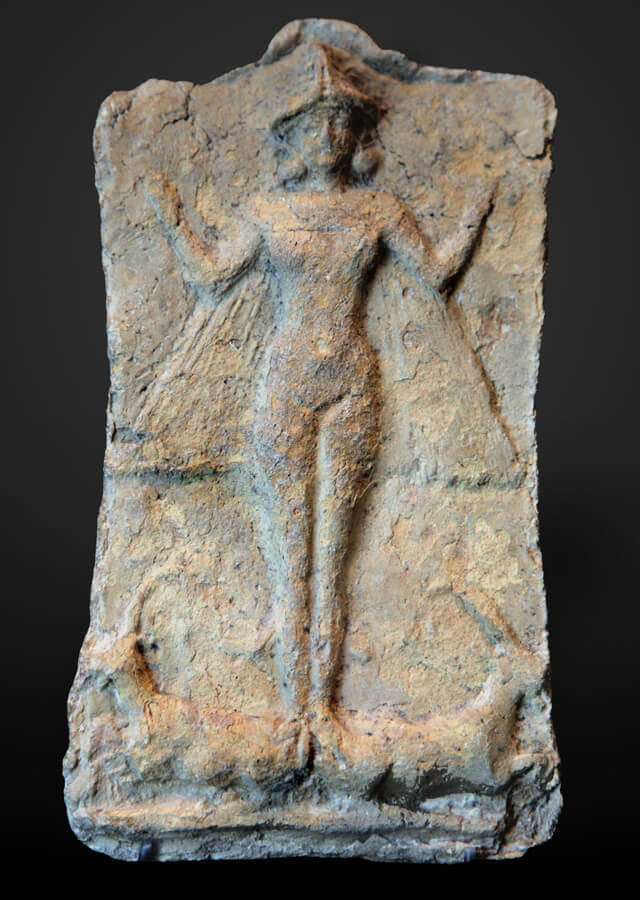
Additionally, and according to some other variants, the bird claws may indicate the beginning of a transformation. The goddess, entering the domain of her sister (her symbolic adversary and contrary) is gradually metamorphosing and adapting to her new condition in that cave of damnation.
The psychological descent as an act of self discovery has its solid foundations in this mythological scene. I personally see Inanna fusing with her own sister, her dark antagonist from the same self. Two bodies, one of light and one of darkness finding their equilibrium.
It appears that Joseph Campell on his influential work “The Hero with a Thousand Faces” (1949) supports a similar theory:
“Inanna and Ereshkigal, the two sisters, light and dark respectively, together represent, according to the antique manner of symbolization, the one goddess in two aspects; and their confrontation epitomizes the whole sense of the difficult road of trials. The hero, whether god or goddess, man or woman, the figure in a myth or the dreamer of a dream, discovers and assimilates his opposite (his own unsuspected self) either by swallowing it or by being swallowed. One by one the resistances are broken. He must put aside his pride, his virtue, beauty, and life, and bow or submit to the absolutely intolerable. Then he finds that he and his opposite are not of differing species, but one flesh.”
Knowing that the two sisters reached an agreement at the end of the tale, it’s safe to put this idea on the table. The balance was achieved after a time of turmoil.
The owl-like creatures on the sides are many times associated with the goddess Ereškigal, due their obscure characteristics. In this case, the inhabitants of this particular underworld are said to dress bird’s feathers (owls are actually very rare in Mesopotamian iconography). Standing aside like columns, they seem to contextualise the scene assuming the role of gatekeepers that prevent Inanna to enter freely in that shadowy domain.
The “Rod-and-Ring” in her raised hands are frequently displayed in Mesopotamian art, normally held by gods, goddesses and sometimes by a king. They indicate the divine status of the character who holds it.
The exact nature of these objects are still a mystery and it is thought to depict a pair of measuring instruments, a rule and a tape – Probably as a symbol of divine justice as well as symbolic measuring of time, eternity (the cyclic motion of the ring) and transcendence – The divine rule that connects the ring to the earth and a measurer of the finite, as the chronologic weight that shapes the life on Earth.
In contrast, while separated, these objects may symbolise mortality and ephemeral life.
In “Inana’s descent to the nether world” these objects are referred as part of her “gear” while in that dark place : “(…) She placed a golden ring on her hand. She held the lapis-lazuli measuring rod and measuring line in her hand.” – translation by The ETCSL project, Faculty of Oriental Studies, University of Oxford, 2003-2006.
This study strengthened our theory that the “Burney Relief” from the British Museum may actually be a depiction of Ištar (Babylonian) at the gates of the Netherworld.
In our personal depiction of the goddess we wanted to use this relief as inspiration. It’s a fact that unriddling this piece of art made us question ideas that we wanted to explore as we started. So, for our own version we decided to change some of the symbols and elements to suit our original thought. And that’s why we didn’t want to call it “Burney Relief” or “Queen of the Night Relief”, we wanted to feel free to play around with our distorted minds and make our typical visual “mishmash”.
The first time we saw this terracotta relief it reminded me of some kind of archaic vampiric mythology. When I looked at it, I almost felt like something was choking me and draining my energy away- it is normally a bad sign but I kinda liked it, it was inspiring somehow.
The way the gods were portrayed by the Sumerians allow my imagination to create an ancient vampiric worship, probably fuelled by the myth of Lilith as a vampire goddess and the chronicles of Cain in the dark fields of the Land of Nod – I admit the enormous influence that the Vampire: the Masquerade games have in me, I just love the universe they built.
So, for me it was easy to conceptualise a figure of Inanna/ Ištar covered in gold garments and Lapis-lazuli jewellery. A powerful goddess, untouchable, dangerous.
I didn’t follow with exact detail the descriptions of her outfit in the ancient texts, I preferred to give her a different, exotic look – and I need to be honest, I cannot fall in love with that original horned hat she wears, it reminds me an ugly wig.
For the rest of her physical atributes, we both agreed to give her a strong sexual look and a violent energy. The claws are evidently more aggressive, like a bird of prey and she seems to taste some drops of blood.
The other hand pours a libation upon the figure on the bottom. “The practice of libation — pouring out a liquid for ritual purposes — was an essential accompaniment to all forms of sacrifice and offering in ancient Mesopotamia.“ – Jeremy Black, Anthony Green, “Gods, Demons and Symbols of Ancient Mesopotamia An Illustrated Dictionary”, 1992.
For the demon birds and Rods and Rings on her hands, we just followed the same symbolism as the original relief. The lions were intentionally removed to avoid the visual conflict, keeping her bird-like aspect to predominate. I know the lions are one of her main symbols, but in this case they just didn’t make sense if we wanted to follow a hypothetical vampire alternative.
The four arms instead of two seem to connect two different realms, the lower and dark realm defined by the front arms and the higher realm represented by the raising arms with the sacred instruments on her hands.
The snakes on the background and tattooed in her legs are an important symbol for erotic love and fertility as well as the lower realm (like the snakes that hide under the dark rocks). In some traditions, like Judaism, the snake may also represent the demonic features of Lilith – we wanted to include this tiny reference to her due to her popular connection to vampirism in modern days. But just to be clear, I’m truly convinced that Lilith is not the figure on this terracotta relief.
This text is way longer than I expected. There were too many things I didn’t know about the Mesopotamian mythology, so I guess I got too excited, sorry about that.
 No products in the cart.